
The Secret to Living Longer Might Be Simpler Than You Think
You don’t need expensive gym memberships, fancy equipment, or high-tech gadgets to understand how well you’re aging. According to a groundbreaking study, simple fitness tests you can perform at home may offer powerful clues about your health and lifespan.
The good news? You probably already have everything you need to get started.
What a Major Study Reveals About Fitness and Longevity
A recent study published in JAMA Network Open examined the connection between physical fitness and mortality in over 13,000 older adults (average age: 65+). The results are eye-opening.
Key Finding: Older adults who performed better on fitness assessments measuring strength, mobility, and flexibility had significantly lower mortality rates over a seven-year period compared to those who scored lowest.
Study Details:
- Participants: 13,000 Taiwanese adults, ages 65 and older (mostly female)
- Duration: January 2015 to November 2016, with 7-year follow-up
- Method: Objective fitness tests (not self-reported data)
- Results: High performers had dramatically lower death risk from all causes
The 4 Key Fitness Areas That Predict Longevity
Researchers assessed participants across four critical areas of physical fitness. Here’s what they tested and why it matters:
1. Cardiorespiratory Fitness: The Two-Minute Step Test
What It Measures: Heart and lung capacity—essential for endurance and overall cardiovascular health.
How It Works: Stand in place and lift one leg at a time for two minutes. Count how many complete steps you can do.
Why It Matters: Strong cardiovascular fitness is linked to better heart health, reduced disease risk, and increased longevity.
2. Muscular Strength: Arm Curls & Chair Stands
What It Measures: Upper and lower body strength—crucial for independence and fall prevention.
How It Works:
- Arm Curls: Perform dumbbells curls (5 lbs for women, 8 lbs for men) for 30 seconds
- Chair Stands: Rise from a seated position without using your arms (arms crossed on chest), repeatedly for 30 seconds
Why It Matters: Lower-body strength was especially important for women in the study. Strong legs help you stay independent, climb stairs, and prevent falls.
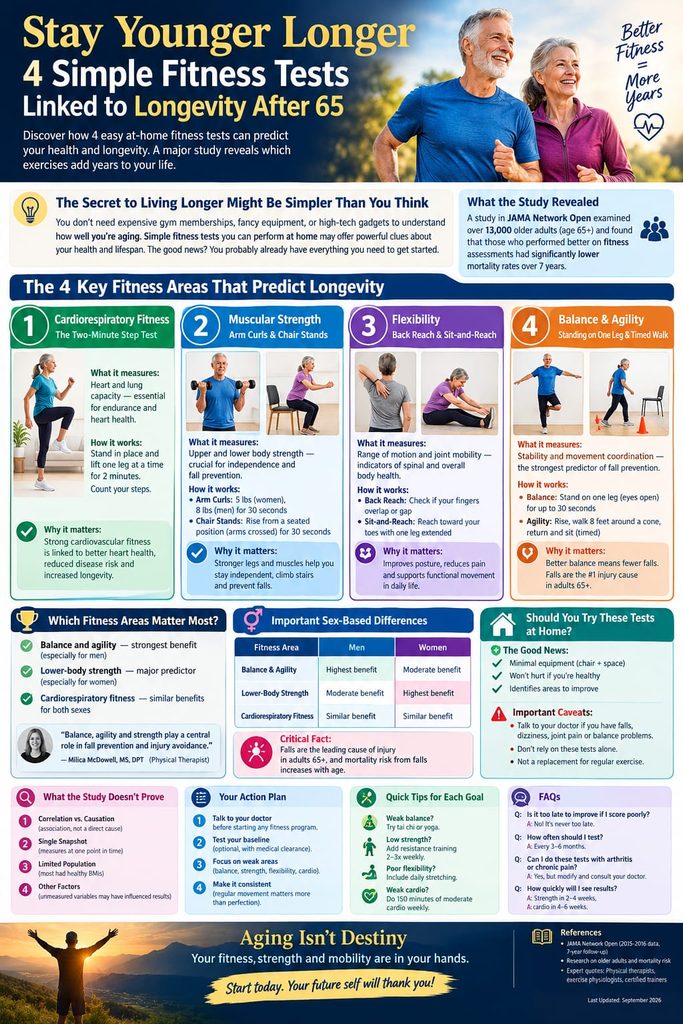
3. Flexibility: Back Reach & Sit-and-Reach Tests
What It Measures: Range of motion and joint mobility—indicators of spinal and overall body health.
How It Works:
- Back Reach: Reach both hands behind your back; measure if fingers overlap (positive) or gap (negative)
- Sit-and-Reach: Extend one leg and reach toward your toes while the other leg stays bent
Why It Matters: Good flexibility improves posture, reduces pain, and supports functional movement in daily life.
Fitness Routine Generator
This tool creates personalized workout plans based on your fitness level and goals. Whether you’re a beginner or looking to improve an existing routine, it generates practical exercise plans that are simple to follow and easy to adjust.
Link:
[https://trueglobalcare.com/fitness-routine/ ]
4. Balance & Agility: Standing on One Leg & Timed Walk
What It Measures: Stability and movement coordination—the strongest predictor of fall prevention.
How It Works:
- Balance Test: Stand on one leg with eyes open for up to 30 seconds
- Agility Test: Rise from a chair, walk 8 feet around a cone, return to chair, and sit (timed)
Why It Matters: This combination was the strongest predictor of mortality reduction, particularly in men. Better balance means fewer falls, and falls are the #1 injury cause in adults 65+.
The Shocking Results: Which Fitness Areas Matter Most?
The study revealed compelling differences in what predicts longevity:
Overall Winners:
✓ Balance and agility — Strongest mortality benefit (especially for men)
✓ Lower-body strength — Major predictor of life expectancy (especially for women)
✓ Cardiorespiratory fitness — Similar benefits for both sexes
Why These Areas Matter Most:
According to physical therapist Milica McDowell, MS, DPT:
“Balance, agility, and strength play a central role in fall prevention and injury avoidance.”
Critical Fact: Falls are the leading cause of injury in adults 65+, and mortality risk from falls increases with age. This explains why balance and strength are such powerful longevity predictors.
Important Sex-Based Differences (What Men & Women Should Know)
The study uncovered significant gender differences in fitness outcomes:
| Fitness Area | Men | Women |
|---|---|---|
| Balance & Agility | Highest mortality benefit ⭐ | Moderate benefit |
| Lower-Body Strength | Moderate benefit | Highest mortality benefit ⭐ |
| Cardiorespiratory Fitness | Similar risk reduction | Similar risk reduction |
What This Means: Women should prioritize squats and leg strength; men should focus on balance training. Both should maintain cardiovascular fitness.
Should You Try These Tests at Home? Expert Advice
The Good News:
✅ These tests require minimal equipment (just a sturdy chair and space)
✅ Testing at home can’t hurt if you’re healthy
✅ Results help identify fitness areas worth improving
Important Caveats:
⚠️ Talk to your doctor first if you have:
- History of falls
- Unsteadiness or dizziness
- Joint or muscle pain
- Balance problems
⚠️ Don’t rely on these tests alone—they’re a snapshot, not a complete health picture
⚠️ These are NOT replacements for regular aerobic exercise and strength training
What the Study Doesn’t Prove (And Why It Matters)
Before you panic about your fitness level, remember these important limitations:
1. Correlation vs. Causation
The study shows an association between fitness and longevity, not that poor fitness causes early death.
2. Single Snapshot
Tests measure fitness at one moment in time, not how your fitness changes over years.
3. Limited Population
Most participants had healthy BMIs. Results may not apply to adults with frailty or serious chronic illness.
4. Other Factors
Unmeasured variables could have influenced the results.
The Bottom Line: How to Use These Findings
For Healthy Older Adults:
Consider these fitness tests as tools to identify areas for improvement. Use them to motivate yourself toward better fitness, not to worry about your health.
For Healthcare Providers:
These assessments could become standard screening tools in routine check-ups to identify:
- Adults at risk for falls
- Those with low cardiovascular reserve
- Candidates for preventive exercise programs
For Everyone:
Remember that fitness is improvable. As certified personal trainer Domenic Angelino noted:
“Poor performance simply indicates that your fitness might be a bit lower.”
Smart AI Health Calculator
This AI-powered tool provides a precise Body Mass Index (BMI) calculation along with daily calorie analysis. Enter your age, height, weight, and activity level to receive clear health insights through a modern, user-friendly interface.
Link:
[ https://trueglobalcare.com/ ]
Your Action Plan: Start Building Longevity Today
- Talk to your doctor before starting any new fitness program
- Test your baseline (optional, with medical clearance)
- Focus on your weak areas:
- Weak balance? Try tai chi or yoga
- Low strength? Add resistance training 2-3x weekly
- Poor flexibility? Include daily stretching
- Weak cardiovascular fitness? Do 150 minutes of moderate cardio weekly
- Make it consistent — Regular movement matters more than perfection
FAQs About Fitness and Longevity
Q: Is it too late to improve if I score poorly?
A: No! Fitness improvements at any age improve health and function. It’s never too late to start.
Q: How often should I test myself?
A: Every 3-6 months is reasonable to track progress, but focus more on consistent training.
Q: Can I do these tests if I have arthritis or chronic pain?
A: Yes, but modify movements and consult your doctor first.
Q: How quickly will I see results?
A: Strength improves in 2-4 weeks, cardiovascular fitness in 4-6 weeks.
Final Thoughts: Aging Isn’t Destiny
This study delivers an empowering message: How you age isn’t entirely up to chance. Your fitness, strength, and mobility are largely within your control.
You don’t need expensive equipment or gym memberships. Simple, consistent exercise targeting these four areas—cardiorespiratory fitness, strength, flexibility, and balance—can add healthy years to your life.
The question isn’t whether you’re aging well. The question is: What will you do about it?
Ready to improve your fitness? Start with your doctor, then build a sustainable routine. Your future self will thank you.
References
- Study: JAMA Network Open (2015-2016 data, 7-year follow-up)
- Source: Research on older adults and mortality risk
- Expert quotes: Physical therapists, exercise physiologists, certified trainers